Speed to lead: reach every new lead within minutes
Speed to lead is the time between a lead raising a hand and your first real contact with them. It's one of the few sales numbers that's simple to measure and expensive to ignore.
300 credits across all three Engines. No card required. Plans from $197/month.
Contact new leads as fast as you can, ideally within minutes. In a Harvard Business Review study of 1.25 million leads, companies that tried to contact a lead within an hour were nearly 7 times as likely to qualify it as those that waited even an hour longer, and more than 60 times as likely as those that waited 24 hours or more. Speed to lead software like The Engine fixes this by contacting every new lead automatically, by call, text and email, day or night. The Engine's average lead response time is under 60 seconds.
What the research says
The most cited study is Harvard Business Review's 2011 analysis of 1.25 million leads at 42 US companies [1]:
| Finding | Number |
|---|---|
| Tried to contact within an hour vs. an hour later | Nearly 7x as likely to qualify the lead |
| Within an hour vs. 24 hours or more | More than 60x as likely |
| Companies (of 2,241 audited) that responded within an hour | 37% |
| Companies that never responded | 23% |
| Average response time (among those that responded within 30 days) | 42 hours |
The data is old, but the behavior it describes hasn't changed: a lead who just filled in your form is paying attention now and is filling in your competitor's form next.
Measure your own speed to lead in 15 minutes
- Export your last 50 leads with their arrival time.
- For each, find the first real contact: a call that connected, or a personal text or email. An auto-reply doesn't count.
- Calculate the gap for each and take the median.
- Split by business hours vs. nights and weekends. That second number is usually the problem.
Then put your numbers into the speed to lead calculator to estimate what slow response costs you.
Why teams are slow (and it's not laziness)
- Leads arrive after hours. Nobody's there.
- Reps are on other calls. The new lead waits in a queue.
- Follow-up falls off. One attempt, then the lead is forgotten.
- Too many tools. The lead lands in one system and the dialer is in another.
How The Engine fixes it
| Step | What happens |
|---|---|
| Lead arrives | Form, ad lead, CRM or a call to your number |
| Under 60 seconds on average | Jessica calls, then texts and emails if she can't connect |
| Conversation | She asks your qualification questions |
| Booked | Appointment booked with your team |
| No answer | Follow-up continues on your cadence until the lead books, says no or opts out |
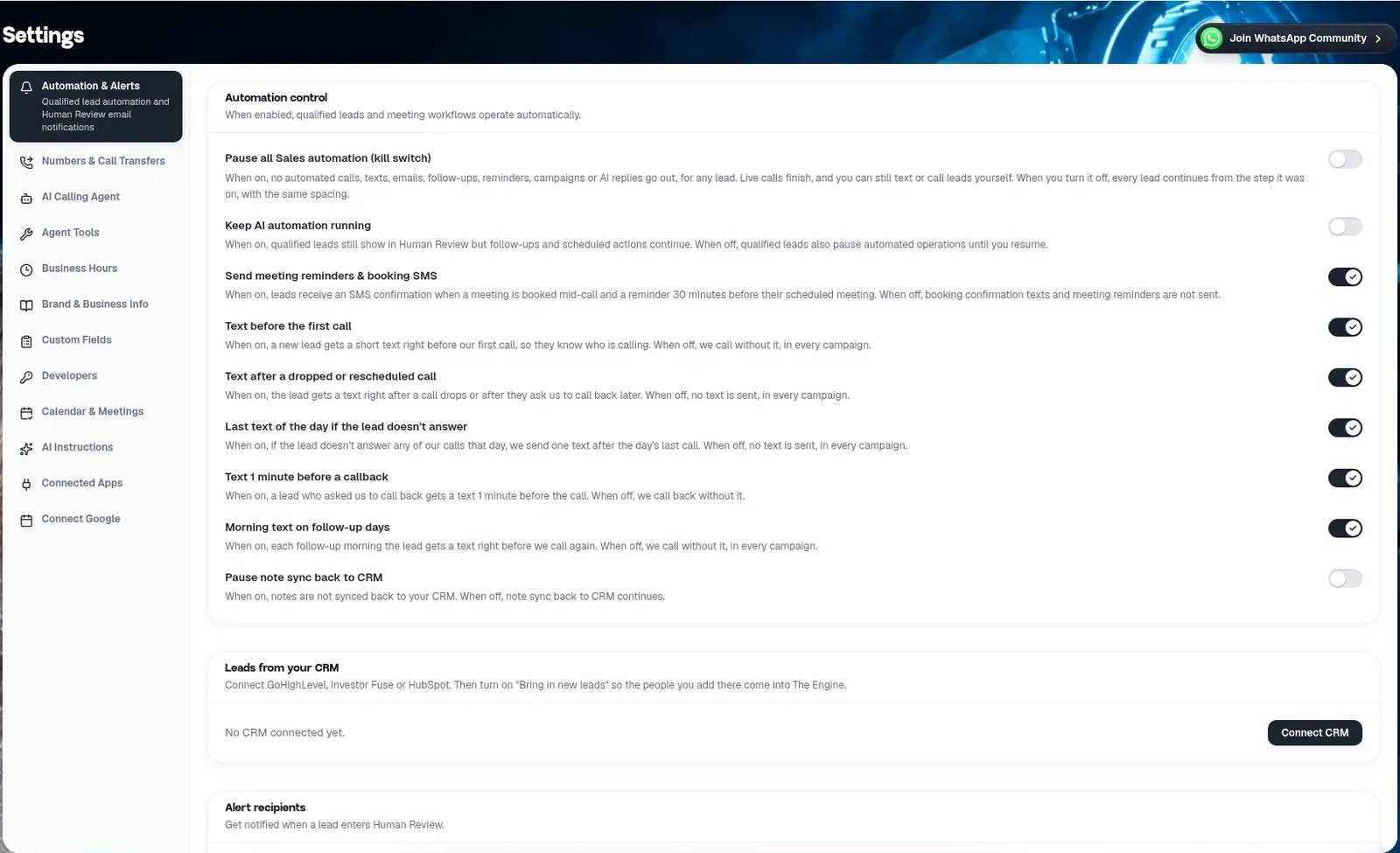
You set the campaign, the qualification rules and the cadence. Humans review plans and make judgment calls. It works with GoHighLevel, HubSpot, Salesforce, Zoho, Podio, Slack, Claude and ChatGPT, plus MCP, APIs and webhooks for custom integrations.
Other ways to improve speed to lead
Not every fix needs software. Honest options:
- Route new leads to a phone, not an inbox, so someone sees them right away.
- Staff a shared on-call rotation for nights and weekends.
- Use a missed-call text back so callers get a reply even if you can't pick up.
- Use an answering service if you want a human voice and can afford per-call pricing.
These work at small volume. Once leads come in faster than people can call them, or mostly outside business hours, automated follow-up is usually the only way to stay fast on every lead.
Speed-to-lead checklist
- ☐ Every lead source (forms, ads, calls, CRM) feeds one place.
- ☐ A first call or text goes out within a minute, day and night.
- ☐ Follow-up continues for at least a week on call, text and email.
- ☐ Leads who ask for a person are transferred or routed fast.
- ☐ You review response time weekly, split by after-hours.
Compliance
Get consent. In February 2024 the FCC confirmed that AI-generated voices count as "artificial" voices under the TCPA, which generally requires prior express consent for these calls [2]. Put consent language on your forms and honor opt-outs right away. This isn't legal advice.
Frequently asked questions
What is speed to lead?
Speed to lead is the time between a lead contacting you, for example by filling in a form or calling, and your first real response. Shorter is better.
How fast should you respond to a new lead?
As fast as you can, ideally within minutes. A Harvard Business Review study of 1.25 million leads found companies that tried to reach a lead within an hour were nearly 7 times as likely to qualify it as those that waited even an hour longer.
How do I measure my speed to lead?
Take your last 50 leads. For each, record when the lead arrived and when someone first made real contact by phone, text or email. The median of those gaps is your speed to lead. Track after-hours and weekend leads separately.
What is speed to lead software?
Software that contacts new leads automatically the moment they arrive. The Engine's Sales Engine does this with Jessica, an AI voice agent who calls, texts and emails new leads within minutes, qualifies them and books appointments.
Can AI call my leads legally?
Outbound AI calls fall under the TCPA. In 2024 the FCC confirmed AI-generated voices count as artificial voices, which generally require prior express consent. Capture consent on your forms and honor opt-outs. This isn't legal advice.
Put The Engine to work this week
Start your 7-day free trial: 300 credits across all three Engines, no card required. Nothing is charged automatically when the trial ends.
Related
Sources
- Harvard Business Review, "The Short Life of Online Sales Leads" (2011): https://hbr.org/2011/03/the-short-life-of-online-sales-leads (checked Nov 18, 2026)
- FCC, "FCC Confirms that TCPA Applies to AI Technologies that Generate Human Voices" (2024): https://www.fcc.gov/document/fcc-confirms-tcpa-applies-ai-technologies-generate-human-voices (checked Nov 18, 2026)